The Grammar Index Blog

Grammar explained, teaching ideas, and news from the apps.

16 posts matching “English Grammar”

Learning English

Multilingual English Grammar Website for Learners

Grammar practice is easier to follow when the explanation makes sense before the exercise begins. A multilingual English grammar website can bring definitions, worked examples, quizzes, and review together; this platform covers over 300 topics and is offered in 34 languages. That gives learners ways to understand a rule and practise using it. If English grammar feels confusing, you’re not alone. A new rule can be difficult to absorb when its explanation is hard to follow. This article explains how exercises and quizzes turn understanding into practice, how multilingual content can make explanations more accessible, and what to look for in a study resource. You’ll also see how structured review can support steady progress, whether you’re learning a grammar point for the first time or revisiting it to build confidence.


Teaching

Daily Grammar Practice Routine for Everyday English Sentences

Use the present simple to describe everyday routines: “I get up” and “she gets up.” A daily grammar practice routine can pair this pattern with common phrasal verbs and collocations, helping you build clear sentences about your day. It’s easy to know what you want to say but hesitate over the verb form or choose a phrase that sounds unnatural. That uncertainty is part of learning, and focused practice gives you a clear way to notice how everyday sentences are put together. Learn how the present simple describes habits, how frequency words add detail, and how phrasal verbs such as “get up” and “tidy up” fit into routine descriptions. Then practise with your own daily activities, connecting grammar to sentences you can use in conversation and writing.

Grammar

Common English Grammar Mistakes Made in Hospitality

The most common English grammar mistakes in hospitality are wrong verb tenses, missing articles (a, an, the), subject-verb agreement errors, confused prepositions of time and place, treating uncountable nouns such as luggage and information as plurals, badly formed questions, and wording that sounds too direct for a guest. Most can be fixed with a short list of patterns that staff practise often: past tense for finished actions, a/an before a single countable noun, at for clock times, and Would you like…? or Could I…? for polite offers and requests. In hospitality, communication shapes the guest experience. Whether you are welcoming guests at reception, answering email enquiries, confirming reservations or replying to online reviews, clear and correct English builds confidence and trust. For hotels, restaurants, resorts, tour operators and event venues with international teams, a few grammar habits can make the difference between a guest who feels looked after and one who feels confused. This guide explains ten frequent mistakes, shows how to correct each one, and suggests a practical way to build grammar practice into a busy working week.

formal English grammar

Common punctuation errors: How to punctuate clauses, quotes and lists

Fix common punctuation errors by matching each mark to its job: use commas to separate introductory elements and list items, semicolons to join closely related complete clauses, quotation marks to show exact words, and apostrophes for possession or contractions, not ordinary plurals. If a comma joins two sentences on its own, replace it with a period or semicolon, or add a coordinating conjunction. These are practical rules for understanding common punctuation errors and how to fix them. Punctuation can feel confusing because small marks change a sentence’s structure and meaning. A few clear checks can help you spot and correct frequent mistakes. This guide explains common punctuation errors and how to fix them, with examples of commas and lists, quotation-mark placement, semicolons, and apostrophes. Practise these checks to recognize and correct errors in your own writing.

formal English grammar

Master business email grammar and etiquette with this practical guide. Learn how to write clear, professional, and courteous messages that get quick results.

An email can be grammatically correct and still leave the reader unsure what to do next. That often happens when clear wording and professional tone are treated as separate concerns. Business email grammar and etiquette work best together: grammar makes the message easy to understand, while etiquette helps it feel appropriate to the person receiving it. If you’re unsure how formal to sound, how direct to be, or whether a sentence says what you intend, you’re not alone. A rushed phrase, unclear request, or awkward tone can distract from your point. The solution isn’t to memorise a long list of disconnected rules. Use a simple method that connects your audience, purpose, wording, and review.

Product news

Best Advanced Grammar Apps for Professionals: 2026 Guide

Does relying on a basic spellchecker actually make you a better writer, or is it just a temporary bandage for a deeper lack of confidence? Many experts find that while AI tools are fast, they often strip away the nuanced meaning required in high-stakes professional environments; leaving you worried about sounding unprofessional in a critical report. It is a common cycle: you look up a complex rule, apply it, and then forget it almost immediately because the tool did the thinking for you.

Product news

Why Use a Dedicated Grammar Learning App? 6 Benefits for 2026

What if the grammar rule you looked up last week didn’t disappear as soon as you closed the tab? When explanations and exercises are scattered across different resources, it can be hard to connect a rule with the practice that helps you recall and apply it. If you’re wondering why use a dedicated grammar learning app, the practical answer is that it brings explanations, examples, quizzes, and review into one focused study routine.

Learning English

Master English Punctuation and Grammar: A Practical Reference Guide

What if grammar and punctuation aren’t separate lists to memorise, but parts of one system for making meaning clear? To master English punctuation and grammar, you need to see how sentence structure and punctuation work together. If rules feel disconnected, it’s hard to know where to begin. A comma, colon, or full stop can change how a sentence reads, even when you recognise the rule in an example. Applying it to your own writing takes practice, not just memorisation.

Teaching

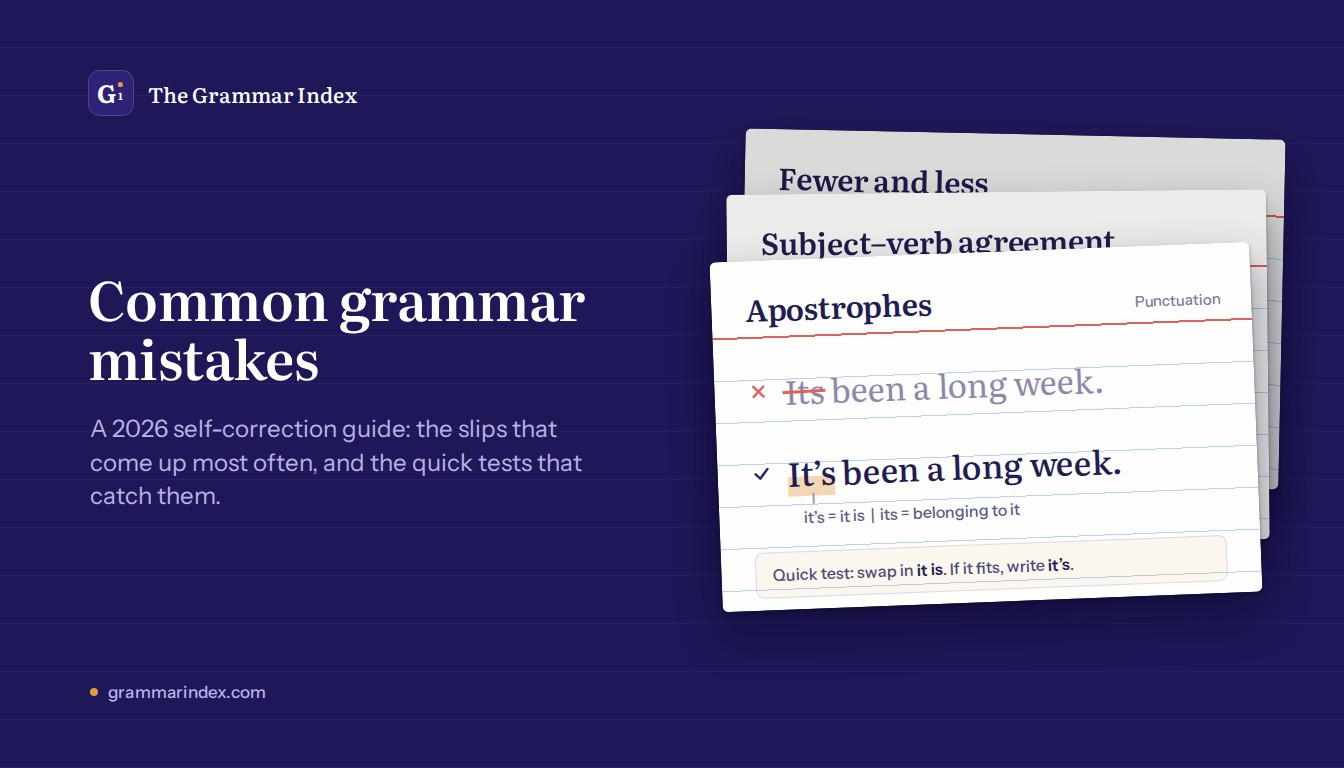
Common Grammar Mistakes: 2026 Self-Correction Guide

Nearly 80% of hiring managers immediately disqualify applications containing basic writing errors, yet automated tools still let embarrassing missteps slip through unnoticed. Software alerts merely flag surface symptoms without teaching genuine precision. Achieving long-term accuracy and correcting common grammar mistakes requires diagnosing the root structural habits that generate errors, rather than blindly trusting algorithmic suggestions that warp your intended meaning.

An unhandled error has occurred. Reload Close