Daily Grammar Practice Routine for Everyday English Sentences
Use the present simple to describe everyday routines: “I get up” and “she gets up.” A daily grammar practice routine can pair this pattern with common phrasal verbs and collocations, helping you build clear sentences about your day. It’s easy to know what you want to say but hesitate over the verb form or choose a phrase that sounds unnatural. That uncertainty is part of learning, and focused practice gives you a clear way to notice how everyday sentences are put together. Learn how the present simple describes habits, how frequency words add detail, and how phrasal verbs such as “get up” and “tidy up” fit into routine descriptions. Then practise with your own daily activities, connecting grammar to sentences you can use in conversation and writing.
Daily Grammar Practice Routine for Everyday English Sentences
Use the present simple to describe everyday routines: “I get up” and “she gets up.” A daily grammar practice routine can pair this pattern with common phrasal verbs and collocations, helping you build clear sentences about your day.
It’s easy to know what you want to say but hesitate over the verb form or choose a phrase that sounds unnatural. That uncertainty is part of learning, and focused practice gives you a clear way to notice how everyday sentences are put together.
Learn how the present simple describes habits, how frequency words add detail, and how phrasal verbs such as “get up” and “tidy up” fit into routine descriptions. Then practise with your own daily activities, connecting grammar to sentences you can use in conversation and writing.
Key Takeaways
- Use the present simple to describe habits, and pay attention to the verb form when the subject is he, she, or it.
- Add frequency words and everyday time expressions to make routine descriptions more precise.
- Learn phrasal verbs such as “get up” and “tidy up” in complete sentences so you can use them naturally.
- Choose practice materials that explain grammar clearly and let you review examples and test your understanding.
Table of Contents
- Present simple forms for describing routines
- Phrasal verbs and collocations for routines
- What grammar topics should beginners practice first?
- How can you practice grammar using books, apps, and websites?
- The Grammar Index: The Grammar Index Multilingual Edition
Present simple forms for describing routines
The present simple describes habits and routines, such as “I wake up early.” Use the base verb with “I,” “you,” “we,” and “they.” With “he,” “she,” or “it,” verbs usually take -s or -es: “She walks to work” and “He watches the news.”
Build a routine description with an affirmative, a negative, and a question. For example: “I eat breakfast at 8:00 a.m.” “I don’t eat lunch at home.” “Do you go to work at a quarter past eight?” For a third-person subject, ask, “Does she get dressed at half seven?”
Frequency adverbs show how often an activity happens. “Always” represents 100%, while “never” represents 0%. “Usually” or “normally” describes about 90%; “often” or “frequently,” about 70%. “Sometimes” is about 50%, “occasionally” about 30%, and “hardly ever,” “rarely,” or “seldom” about 10%. Try: “I usually have breakfast at 8:00 a.m.”
Free grammar practice apps and websites are most useful when they combine clear explanations, example sentences, and exercises with answers. Choose a resource that lets you practise a specific point, such as adding -s in “she walks,” rather than relying only on random quizzes.
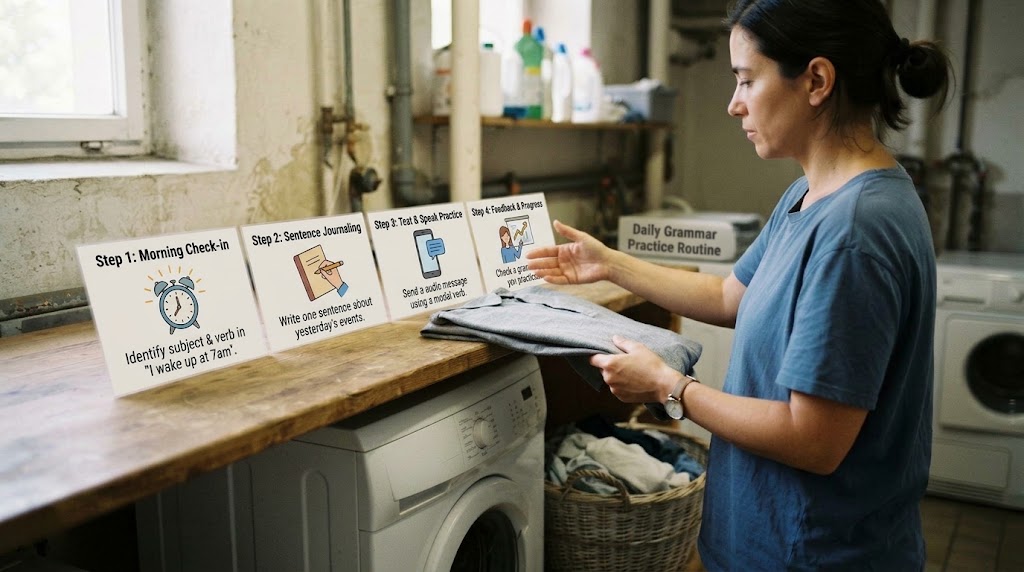
To create a weekly grammar study schedule, assign a clear focus to each study session, then revisit earlier topics. For example, practise present-simple statements first, then negatives, questions, and frequency adverbs. Use a routine sentence each time, such as “I go home at 4:00 p.m.”
To review and correct a grammar mistake, record the original sentence, identify the rule, and rewrite it correctly. If you write “He walk to work,” mark the subject and verb, then correct it to “He walks to work.” Reuse the corrected form in a new sentence.
Avoid memorising rules without applying them, practising only one sentence pattern, or overlooking repeated errors. Don’t practise “I get up” alone: compare it with “She gets up” and “Does she get up?” The contrast makes the subject-verb change clear.
Measure progress by comparing routine descriptions written or spoken at different points. Check whether your present-simple forms, questions, and frequency words are accurate. You can also record a 60-second description of your daily routine and listen back for errors, such as missing -s in “she starts.”
Phrasal verbs and collocations for routines
Phrasal verbs combine a verb with a particle, as in “get up” or “tidy up.” They help you describe routine actions naturally. Learn each phrase in a sentence, not as an isolated translation: “I tidy up the kitchen after breakfast” shows its meaning in context.
Some phrasal verbs change meaning with context. “Wash up” can mean washing dishes after a meal, while “get up” means getting out of bed. Add a time or object to make the action specific: “I wash up after dinner” or “She gets up before sunrise.” These examples also show how the verb changes with the subject.
Collocations are words that commonly appear together. Learn them as useful combinations, then use them in a sentence about your routine:
- Make the bed: “I make the bed before I leave.”
- Have a shower: “He has a shower after his run.”
- Catch the bus: “We catch the bus near the library.”
Choose one part of the day and write three connected sentences. For example: “I get up early. I make the bed. Then I have breakfast.” Change “I” to “she” to practise subject-verb agreement: “She gets up early and makes the bed.” Read both versions aloud to notice the changes.
Keep a phrase record with three details: the expression, its meaning in context, and an original example. For “tidy up,” you might write, “I tidy up my desk before work.” Review the phrase when describing another day, adjusting the object or time to fit.
For more examples and structured grammar practice, explore this English grammar reference and use its explanations to support sentence building.

What grammar topics should beginners practice first?
Start with sentence structure: subject, verb, then the remaining information. In “Maya reads books,” Maya is the subject, reads the verb, and books the object. This order gives you a dependable frame before you add detail.
Next, practise be and basic auxiliaries. Compare “I am ready” with “I work today.” Some questions use a different word order from statements, so practise them with examples. Use do for many present-simple questions: “Do you work today?”
- Pronouns: Replace “Maya and I” with “we” in “We study English.”
- Negatives: Form “isn’t ready” and “doesn’t work” correctly.
- Articles: Compare “a book” with “the book” in context.
- Plurals: Practise “one class” and “two classes.”
These foundations help beginners make statements, questions, and short answers. Practise one pattern at a time, then combine them: “Is Maya ready?” “No, she isn’t.” “Does she have her book?” The contrast shows which auxiliary belongs in each structure.
After sentence patterns, add prepositions and time expressions. Compare “at 8:00 a.m.” with “on Monday” and “in the evening.” Put each phrase into a complete sentence, such as “We study English on Monday.” A sentence makes the relationship between words easier to see.
Practise connecting ideas with words like and, but, and because. “I walk to class, but my sister takes the bus” combines two clear clauses. “I study because I have a test” gives a reason.
Use a short practice sequence: write a statement, turn it into a question, make it negative, then add a time or reason. For example, change “They are at home” to “Are they at home?” and “They aren’t at home.” This builds flexible control, not just recall of isolated rules.
How can you practice grammar using books, apps, and websites?
Use a grammar book when you need a connected explanation and examples. Read about one focused topic, such as articles, then compare “a” and “the” in sample sentences. Complete the exercises before checking the answers. For each error, write your own corrected sentence, such as “I saw a bird. The bird was blue.” This turns a rule into a pattern you can use.
An app can help you revisit short exercises and identify topics that need attention. Choose a focused activity, answer each item, then read the explanation for any incorrect response. If you confuse “is” and “are,” make two new examples: “The room is quiet” and “The rooms are quiet.” Save the contrast for later review instead of repeating the same quiz without reflecting on your answers.
Websites are useful when you need to check a specific question while writing. Search a trusted grammar reference for the topic, compare its examples, and apply the pattern to your sentence. For example, check whether “She enjoy music” needs a verb change, then rewrite it correctly. Focus on one rule and practise it before moving on, rather than opening several explanations at once.
Combine formats around one learning goal. Read an explanation in a book, complete a related app exercise, then write three original sentences in a notebook. Use a website to resolve any remaining questions. This sequence links explanation, recognition, and independent use, while your examples reveal which forms still feel uncertain.
For a structured reference, explore grammar explanations and practice, then select a topic that matches your current writing. The Grammar Index includes definitions, worked examples, quizzes, and spaced-repetition drills across over 300 topics, helping you move from a rule to repeated practice.
Look for an app with focused exercises, explanations for incorrect answers, and topic review. For a website, the Grammar Index offers definitions, worked examples, quizzes, and spaced-repetition drills across more than 300 topics.
The Grammar Index: The Grammar Index Multilingual Edition
The Grammar Index Multilingual Edition offers a structured English grammar reference, with explanations supported by examples and practice. It can help when you understand a rule but want to revisit it, compare examples, or practise a specific form such as routine verbs.
Because the edition is offered in 34 languages, learners can use multilingual support while developing their understanding of English. Choose a grammar topic that matches your current goal, study its explanation, then apply the pattern in your own sentences. Quizzes and spaced-repetition drills help you return to topics for further practice.
Explore The Grammar Index Multilingual Edition as a reference to complement your regular study. Visit The Grammar Index to explore its learning editions.
Make your next practice session count
Choose a sentence you genuinely need and use it to test what you’re learning. Can you change its subject, make it negative, or ask a question without changing its meaning? This deliberate practice turns grammar from a page of rules into a tool for expressing your own thoughts.
A daily grammar practice routine works best when each session has a clear purpose and leaves you with something to reuse: a corrected sentence, a useful phrase, or a question to explore next. Keep that record nearby so your next session can build on it.
For a reference that supports different learners, The Grammar Index offers The Grammar Index Multilingual Edition, The Grammar Index Original Edition, and Key Stage 2 & 3 Edition. Choose the edition that fits your learning context, then continue exploring English grammar at your own pace.
Contact The Grammar Index for help, and take your next step with confidence.
Frequently Asked Questions
What is an effective daily grammar practice routine for English learners?
Give each study session one clear grammar goal and a chance to use it in original sentences. For example, focus on choosing between “a” and “the” while describing objects in your room. Note any sentences that felt difficult, then revisit them later. This keeps practice relevant to your communication instead of turning it into a set of disconnected rules.
How many minutes a day should you spend practicing grammar?
There is no ideal daily duration for every learner. Choose a study time you can sustain, then adjust it to your focus and the topic’s complexity. A short session may suit a familiar pattern; a new or confusing structure may need more time to understand and apply. Stop when you can use the target form accurately in your own sentences.
What daily exercises improve grammar skills fastest?
Exercises that ask you to produce and revise language show what you understand. Turn a short note about your plans into a complete paragraph, then edit it for sentence structure and word choice. Compare your first version with the corrected one and explain each change in your own words. This shows whether you understand the correction, rather than merely recognizing an answer.
Which free grammar practice apps and websites are best?
Choose apps with focused exercises, explanations for incorrect answers, and topic review. The Grammar Index offers definitions, worked examples, quizzes, and spaced-repetition drills.