Common Grammar Mistakes: 2026 Self-Correction Guide
Nearly 80% of hiring managers immediately disqualify applications containing basic writing errors, yet automated tools still let embarrassing missteps slip through unnoticed. Software alerts merely flag surface symptoms without teaching genuine precision. Achieving long-term accuracy and correcting common grammar mistakes requires diagnosing the root structural habits that generate errors, rather than blindly trusting algorithmic suggestions that warp your intended meaning.
Common Grammar Mistakes: 2026 Self-Correction Guide
Nearly 80% of hiring managers immediately disqualify applications containing basic writing errors, yet automated tools still let embarrassing missteps slip through unnoticed. Software alerts merely flag surface symptoms without teaching genuine precision. Achieving long-term accuracy and correcting common grammar mistakes requires diagnosing the root structural habits that generate errors, rather than blindly trusting algorithmic suggestions that warp your intended meaning.
You already know the frustration of watching an automated assistant scramble your syntax, just as you've likely felt the sting of catching a misplaced modifier right after hitting "send." Arbitrary exceptions and confusing homophones make self-proofreading feel like guesswork, especially when rapid workplace communication clouds your editorial eye.
Lasting accuracy doesn't come from memorizing disjointed rules; it demands an understanding of why specific syntax errors happen. This 2026 self-correction guide breaks down high-frequency structural faults, untangles deceptive word pairs, and equips you with a methodical self-editing framework to eliminate recurring mistakes permanently.
Key Takeaways
- Understand the cognitive disconnect between spoken cadence and written syntax to prevent clause boundary slips before drafting begins.
- Deploy a systematic five-step diagnostic framework for correcting common grammar mistakes, resolving comma splices, run-ons, and dangling modifiers with structural precision.
- Master complex agreement rules across tricky intervening phrases, collective nouns, and singular indefinite pronouns without second-guessing.
- Eliminate persistent homophone confusion and apostrophe misuse using reliable mechanical distinctions between possessive pronouns and verb contractions.
- Implement a multi-pass self-editing protocol and structured reference lookup routine to build lasting muscle memory rather than relying on flawed autocorrect algorithms.
Table of Contents
- Why Do Common Grammar Mistakes Persist in Digital Writing?
- Correcting High-Frequency Syntax Errors: Sentence Structure and Punctuation
- Troubleshooting Agreement and Verb Tense Inconsistencies
- Disentangling Confusing Word Pairs, Homophones, and Mechanics
- Building a Sustainable Framework for Error Elimination and Retention
Why Do Common Grammar Mistakes Persist in Digital Writing?
Most grammatical breakdowns are not acts of careless neglect. Instead, they stem from a cognitive misalignment between how our brains generate spoken language and how formal written syntax demands that thoughts be organized. When composing digital messages under pressure, working memory focuses heavily on conceptual ideation, vocabulary retrieval, and swift delivery. This intense cognitive load leaves minimal mental bandwidth for evaluating clause boundaries, leading writers to overlook basic mechanics and making the process of correcting common grammar mistakes an uphill battle.
For multilingual communicators, this friction multiplies through cross-linguistic interference. When the grammatical blueprints of a writer's native language clash with English conventions, errors emerge naturally. Romance languages, for example, frequently employ flexible, fluid clause chaining where English requires strict mechanical termination. Without a dedicated grammatical reference system to bridge these conceptual divides across languages, native habits instinctively overwrite formal English punctuation rules.
The Cognitive Gap Between Spoken Fluency and Written Syntax
Informal speech relies heavily on vocal inflection, tonal shifts, and physical pauses to separate thoughts. In conversation, a brief breath signals a transition without disrupting comprehension. When that conversational rhythm transfers directly onto the screen, it fractures formal prose. Writers inadvertently insert commas where vocal pauses occur, generating comma splices and run-on sentences that fail the structural test of written English. Because working memory prioritizes expressive speed over syntactic analysis, internal speech cadences slip past self-monitoring filters completely undetected.
The False Security of Passive Automated Spellcheckers
Algorithmic grammar tools promise effortless clarity, yet they frequently create an illusion of competence that actively degrades personal editing skills. Relying entirely on automated checkers introduces distinct hazards:
- Contextual blindness: Software routinely misinterprets homophones and idioms, suggesting grammatically plausible replacements that distort the author's original meaning.
- Atrophy of intuition: Accepting suggested edits without examining the underlying principle prevents writers from internalizing syntactic rules.
- Superficial correction: Algorithms target isolated symptoms, such as an errant comma, while completely missing structural incoherence and illogical clause coordination.
Sustainable mastery requires stepping away from passive correction. Lasting accuracy demands systematically understanding syntax, transforming the task of correcting common grammar mistakes from automated guesswork into conscious linguistic command.
Correcting High-Frequency Syntax Errors: Sentence Structure and Punctuation
Syntax errors rarely happen at random. Instead, they follow predictable structural breakdowns that occur when clause boundaries collapse. A sentence is not simply an arbitrary cluster of words bounded by capitalization and a period; it is a mechanical unit governed by strict rules of predication. Systematic writers rely on a consistent diagnostic workflow when correcting common grammar mistakes:
- Locate the primary verb phrase: Identify the core action or state of being.
- Isolate the subject: Determine precisely who or what executes that action.
- Test for independence: Confirm whether the clause expresses a complete, freestanding thought.
- Examine clause boundaries: Verify that adjacent independent clauses use valid coordination.
- Track modifier proximity: Ensure descriptive elements point unambiguously to their intended targets.
Resolving Comma Splices and Fused Sentences
A comma splice occurs when two independent clauses are joined by only a comma, while a fused sentence omits punctuation entirely. Run-ons are not defined by excessive length; rather, they fail because of illegal clause coordination. Consider this error: The quarterly audit is complete, the leadership team approved the findings. To repair the fracture, apply one of three mechanical solutions:
- Terminal punctuation: Separate into distinct statements (...audit is complete. The leadership team...).
- Semicolon linkage: Join closely related concepts directly (...audit is complete; the leadership team...).
- Coordinating conjunction: Pair a comma with a FANBOYS conjunction (...audit is complete, and the leadership team...).
Eliminating Sentence Fragments and Subordinate Clause Pitfalls
A fragment masquerades as a full sentence while lacking either a finite verb, a true subject, or semantic completeness. Subordinating conjunctions like because, although, and whereas turn independent ideas into dependent clauses. If you write, Although the deployment succeeded without downtime, the thought remains stranded. You must either strip the conjunction or attach the fragment to an adjacent main clause: Although the deployment succeeded without downtime, our team monitored server loads overnight.
Untangling Dangling and Misplaced Modifiers
Descriptive phrases must attach logically to the nouns they qualify. When an introductory participial phrase lacks an immediate, logical actor, it "dangles." For example, Walking into the office, the report caught my eye accidentally suggests that the report possesses legs and strolls into the room. Applying established strategies for revising dangling modifiers requires placing the true subject directly after the introductory comma: Walking into the office, I noticed the report on my desk.
Mastering structural boundaries takes consistent practice. Rather than relying on guesswork, consult The Grammar Index Original Edition to reference structured clause rules and complete targeted drills that cement accurate habits for good.
Troubleshooting Agreement and Verb Tense Inconsistencies
Subject-verb agreement seems straightforward until complex phrases wedge themselves between the subject and the predicate. When sentences expand, writers often match the verb to the nearest noun instead of the true syntactic subject. Successfully correcting common grammar mistakes in complex prose requires stripping away intervening noise to reveal the true grammatical core.
Navigating Deceptive Subject-Verb Agreement Scenarios
Prepositional phrases are the most common source of false agreement. In the sentence, "The batch of newly generated reports are ready," the plural noun reports tricks the ear. The true subject is the singular head noun batch, requiring the singular verb is.
Other common agreement pitfalls follow strict syntactic patterns:
- Correlative conjunctions: When subjects are joined by either...or or neither...nor, the verb must agree with the closer subject (Neither the director nor the analysts were convinced vs. Neither the analysts nor the director was convinced).
- Singular indefinite pronouns: Words like everyone, each, and neither take singular verbs in formal contexts, regardless of descriptive prepositional phrases that follow.
- Collective nouns: In American English, collective terms like team, committee, and faculty take singular verbs when operating as a single unit. British English frequently treats them as plural entities acting individually.
Preventing Unintended Tense and Voice Shifts
Unjustified tense switching breaks narrative momentum. When discussing an established methodology, shifting from past to present mid-paragraph confuses chronological boundaries. Consult Purdue OWL's grammar guide to review how precise aspect sequencing preserves clarity across multi-clause sentences.
Use the past perfect tense (had completed) to establish that one prior event occurred before another past action: "The auditor arrived after the accounting team had reconciled the ledgers." Writing "after the team reconciled" flattens chronological depth. Similarly, avoid jarring shifts from active to passive voice within compound clauses, which obscures the actor and muddles agency.
Mastering Irregular Verb Conjugations and Modal Auxiliaries
Irregular verbs resist basic spelling patterns and demand deliberate memorization. Transitive verbs (which take an object) and intransitive verbs (which do not) are frequently confused:
- Lie vs. Lay: You lie down to rest (intransitive: lie, lay, lain), but you lay the contract on the desk (transitive: lay, laid, laid).
- Rise vs. Raise: Costs rise independently (intransitive), whereas a corporation raises capital (transitive).
Modal auxiliary constructions present another persistent hazard. Phonetic spelling often transforms could have, would have, or should have into the non-standard could of. The contracted form could've sounds identical to could of, but the preposition of can never function as a helping verb. Correcting common grammar mistakes like these requires treating verb strings as precise grammatical formulas rather than approximate phonetic impressions.

Disentangling Confusing Word Pairs, Homophones, and Mechanics
Homophones and mechanical slips erode professional credibility faster than almost any other error. In fact, research indicates that 26.3% of business recipients will refuse to reply to an email that contains internal spelling or grammatical mistakes. While algorithmic tools often swap word variants incorrectly without understanding context, true precision comes from learning the functional roles separating deceptive pairs.
Disambiguating Notorious Homophones and Confusing Word Pairs
Rote memorization often fails during rapid composition. Diagnostic functional tests provide reliable clarity when correcting common grammar mistakes:
- Their vs. There vs. They're: Their indicates possession (possessive pronoun). There denotes physical or conceptual location. They're is strictly a contraction of they are.
- Affect vs. Effect: Use the "RAVEN" framework: Remember, Affect is a Verb (action: to influence), while Effect is a Noun (the result).
- Complement vs. Compliment: A complement with an "e" completes something (e.g., matching data sets). A compliment with an "i" gives praise.
- Principal vs. Principle: The principal is your "pal" or the main financial sum; a principle is a foundational rule or moral standard.
Demystifying Apostrophes: Possession Versus Contraction
Apostrophe misuse often stems from overgeneralizing standard noun rules to pronouns. A core mechanical principle governs English pronouns: possessive pronouns never take an apostrophe. This simple rule cleanly separates hers, yours, ours, and its from verbal contractions.
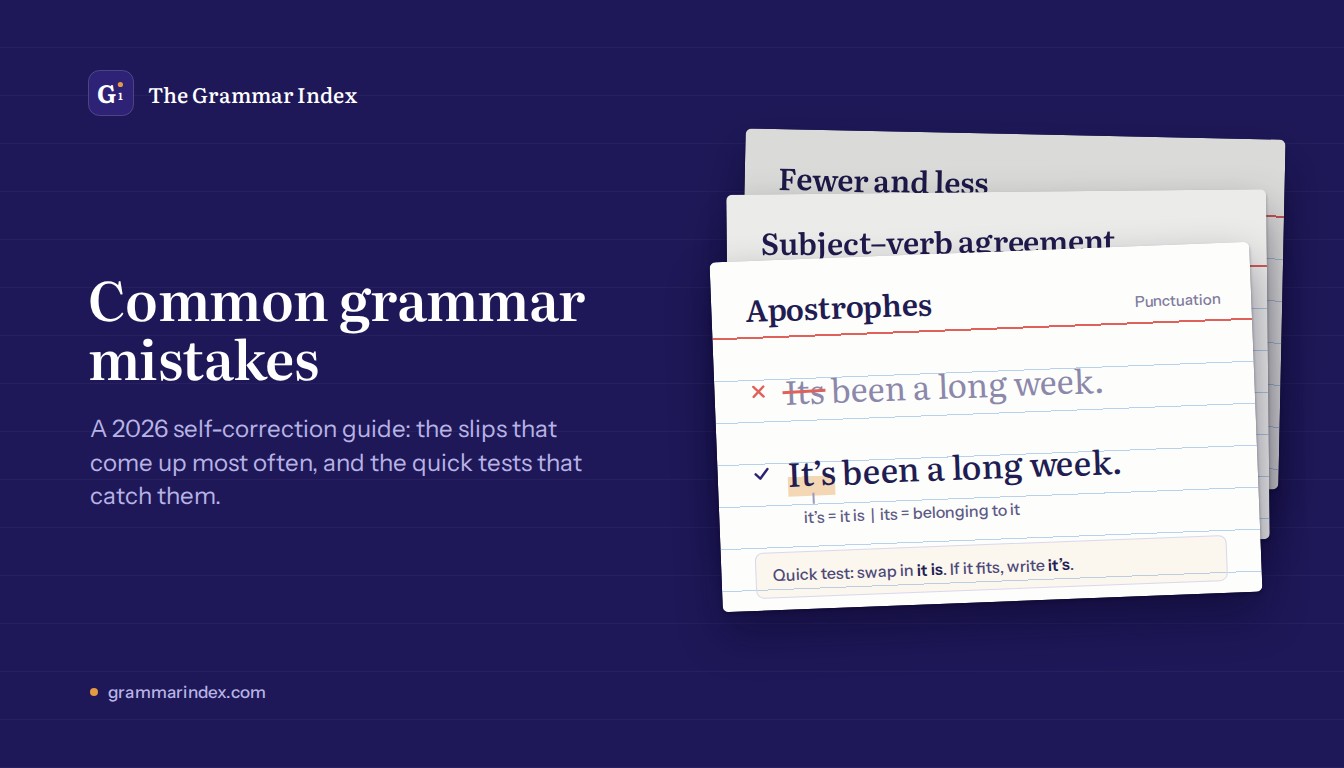
Test the difference between its and it's using simple mental substitution. If substituting it is or it has yields a coherent sentence, insert the apostrophe ("It's [it is] ready for review"). If substitution creates nonsense, use the possessive form ("The platform updated its security protocols"). For plural nouns, append an apostrophe after the s for standard plurals (the clients' feedback), but use an apostrophe before the s for irregular plurals (the children's books). Never use an apostrophe to form a simple plural noun.
Resolving Pronoun-Antecedent Ambiguity and Case Errors
Compound structures frequently mask pronoun case errors. To determine whether to write "between John and I" or "between John and me," temporarily remove the accompanying noun. You would never say "between I," because the preposition demands an objective pronoun; therefore, "between John and me" is correct. Furthermore, beware of ambiguous references where a pronoun could point to two different nouns in the same sentence.
Writers who want to master these nuanced distinctions can benefit from consulting a Multilingual English learning tool. Systematically reviewing these mechanical boundaries builds immediate confidence. To master over 300 topics across comprehensive reference modules, explore The Grammar Index Multilingual Edition and take full control of your writing precision.
Building a Sustainable Framework for Error Elimination and Retention
Knowledge workers spend nearly half of a standard 40-hour workweek solely on written communication, yet recurring errors continue to drain time and authority. Lasting accuracy does not develop by clicking software suggestions; it requires a structured editorial workflow. Transforming the labor of correcting common grammar mistakes from a reactive chore into an instinctive reflex demands an active, systematic approach to editing and retention.
Implementing a Multi-Pass Self-Proofreading System
Reviewing an entire document in a single sweep inevitably causes cognitive fatigue. Instead, separate your editing process into targeted passes:
- Pass 1: Clause Architecture: Audit structural boundaries exclusively. Check each independent clause for proper coordination, eliminating comma splices and unintended fragments.
- Pass 2: Syntactic Agreement: Trace every verb directly back to its head noun, ignoring intervening prepositional modifiers to ensure precise singular or plural harmony.
- Pass 3: Reverse Mechanics: Read the document backward, sentence by sentence, starting from the final line. This isolates syntax from narrative context, exposing typos and homophones that smooth narrative momentum conceals.
- Pass 4: Cadence Read-Aloud: Read the draft aloud or run text-to-speech playback. Engaging auditory processing immediately highlights awkward rhythms, missing prepositions, and misplaced modifiers.
Transforming Passive Knowledge into Automatic Habits Through Spaced Repetition
Cramming theoretical grammar rules creates fleeting awareness, not permanent skill. Long-term accuracy depends on spaced repetition, where specific syntactic challenges are reviewed across systematically expanding intervals. Completing targeted five-minute daily drills builds durable neurological muscle memory. Over time, recognizing subtle errors becomes as effortless as noticing a misspelled word, permanently eliminating vulnerabilities that passive checkers allow through.
Leveraging Systematic Reference Platforms for Lifelong Precision
Active reference lookup builds far stronger grammatical intuition than passive software acceptance. When you look up an unfamiliar rule, you internalize its foundational logic rather than merely repairing an isolated symptom. For multilingual writers, cross-linguistic tools offer vital clarity by mapping English mechanics against the native structural blueprints of 34 distinct languages.
Accessing curriculum-aligned indexes that span 300+ categorized grammatical topics provides a definitive standard for high-stakes documents. Writers ready to cultivate permanent mechanical confidence can explore The Grammar Index Original Edition to replace algorithmic dependency with complete grammatical autonomy.
Achieving Permanent Command Over English Syntax
Mastering written communication requires looking beyond quick software fixes. Lasting editorial authority develops when you learn to identify clause boundaries, resolve deceptive agreement traps, and apply a disciplined, multi-pass proofreading routine. When you shift your approach to correcting common grammar mistakes from passive reliance on automated suggestions to active diagnostic control, recurring errors vanish from your professional correspondence.
True fluency is a matter of consistent practice and reliable reference tools. Navigating complex syntax across modern workplaces requires a structured methodology that builds lifelong writing reflexes.
Equip yourself with a definitive reference system designed for permanent retention. Whether verifying nuanced rules across 300+ categorized grammatical topics or reinforcing concepts through interactive spaced-repetition drills, you can establish lasting mechanical accuracy. Take the next step in your linguistic journey: Master English syntax with systematic drills on The Grammar Index and write every sentence with absolute clarity and authority.
Frequently Asked Questions
What is the single most common grammar mistake in English writing?
The comma splice ranks among the most frequent errors across professional and academic drafts. It occurs when two complete thoughts are linked with only a comma, ignoring required coordinating conjunctions or terminal punctuation. Writers often commit this error during fast screen drafting because their vocal rhythm pauses where punctuation mechanics require a firmer full stop.
How can I stop making comma splices in professional emails?
Audit your draft by isolating independent clauses before sending. If the phrases on both sides of a comma can stand alone as complete grammatical sentences, a comma alone is illegal. Resolve the boundary instantly by substituting a semicolon, inserting a coordinating conjunction like "and" or "but," or dividing the clauses into two crisp sentences.
Why do I still confuse "affect" and "effect", and how do I fix it?
Writers stumble over these terms because they share near-identical pronunciation while fulfilling opposing grammatical functions. In general usage, "affect" functions as a verb meaning to influence, whereas "effect" serves as a noun denoting a result. Applying this operational distinction eliminates guesswork: if an action is taking place, select "affect"; if discussing an outcome, choose "effect."
Is it ever grammatically acceptable to end a sentence with a preposition?
Yes, modern style guides accept terminal prepositions when avoiding them produces unnatural, archaic prose. The historical prohibition was imported from Latin rules that don't match Germanic syntactic structures. While formal documents should avoid careless trailing words, phrasing such as "the scenario we planned for" remains far clearer than forced inversions like "the scenario for which we planned."
Can automated grammar checkers catch every structural error in a document?
No, algorithmic checkers routinely miss subtle structural breakdowns, illogical clause relationships, and context-dependent homophones. Software relies on statistical pattern matching rather than semantic comprehension, frequently suggesting rewrites that distort original intent. Because of this limitation, correcting common grammar mistakes requires human editorial judgment grounded in genuine syntactic rules rather than blind reliance on software prompts.
What is the fastest daily method to improve grammatical accuracy permanently?
Engage in five minutes of targeted micro-practice paired with active reference lookup. Instead of passively accepting automated suggestions, look up unfamiliar mechanics directly in structured reference platforms covering categorized topics. This intentional engagement builds conscious rule recognition, steadily improving your proofreading speed and personal accuracy across all written correspondence.
How does spaced repetition help in mastering irregular English grammar rules?
Spaced repetition optimizes neurological retention by testing challenging grammatical principles across systematically widening time intervals. Instead of cramming complex conjugations in a single sitting, scheduled drills prompt your brain to retrieve structural rules right before forgetting occurs. This structured retrieval practice turns correcting common grammar mistakes into an intuitive reflex, permanently cementing irregular forms into your long-term memory.