Master English Punctuation and Grammar: A Practical Reference Guide
What if grammar and punctuation aren’t separate lists to memorise, but parts of one system for making meaning clear? To master English punctuation and grammar, you need to see how sentence structure and punctuation work together. If rules feel disconnected, it’s hard to know where to begin. A comma, colon, or full stop can change how a sentence reads, even when you recognise the rule in an example. Applying it to your own writing takes practice, not just memorisation.

Master English Punctuation and Grammar: A Practical Reference Guide
What if grammar and punctuation aren’t separate lists to memorise, but parts of one system for making meaning clear? To master English punctuation and grammar, you need to see how sentence structure and punctuation work together.
If rules feel disconnected, it’s hard to know where to begin. A comma, colon, or full stop can change how a sentence reads, even when you recognise the rule in an example. Applying it to your own writing takes practice, not just memorisation.
This guide will help you build a practical foundation, understand how sentence parts fit together, and choose punctuation that supports clarity and tone. You’ll work through core grammar concepts, compare common punctuation choices in context, and follow a manageable routine for practising and revising your writing. The goal isn’t to make every sentence sound formal; it’s to help you make thoughtful choices for your reader and situation.
Key Takeaways
- See how grammar shapes sentence structure and punctuation helps readers follow meaning.
- Build from word roles and phrases to clauses, sentence patterns, and subject-verb agreement.
- Compare commas, semicolons, and colons by the work each one does in a sentence.
- Use a step-by-step editing routine to check meaning, structure, agreement, punctuation, and consistency.
- To master English punctuation and grammar, study clear explanations and examples, then practise and review one rule at a time.
Table of Contents
- Master English punctuation and grammar by understanding what each one does
- Build an English grammar foundation from words to complete sentences
- Choose English punctuation that makes each sentence easier to understand
- Use a practical editing routine to apply grammar and punctuation
- Choose a structured reference to keep mastering English punctuation and grammar
Master English punctuation and grammar by understanding what each one does
Clear writing starts with a practical goal: sentences should be grammatically sound and easy to follow. Grammar and punctuation both help achieve that, but they do different jobs. Grammar is the system of patterns that shapes words, phrases, and sentences. Punctuation is the set of marks that organises writing and clarifies relationships, boundaries, and meaning.
Grammar builds sentence structure; punctuation helps readers interpret it. Once you understand this distinction, the rules feel less like separate instructions and more like parts of one system. To master English punctuation and grammar, first learn how words work together, then use punctuation to make those connections visible.
What belongs to English grammar?
Parts of speech are easiest to understand through their roles, not as a list to memorise. Nouns name people, places, things, or ideas; verbs express actions or states; adjectives describe nouns; and adverbs can modify verbs, adjectives, or other adverbs. A word’s role depends on how it functions in a sentence. For example, in “They watch birds,” watch is a verb describing an action. In “Their watch stopped,” watch is a noun naming an object.
Words combine into phrases, which act as units but may not contain a complete subject-and-verb combination. Clauses contain a subject and a verb; an independent clause can stand as a complete sentence. In “The students read quietly,” the students is the subject and read is the verb. The English grammar foundation also includes how these elements form phrases, clauses, and complete sentences.
Why punctuation is part of clear writing
Punctuation separates ideas and shows how clauses relate. A period marks the end of a statement, while commas can separate items or set off additional information. Colons and semicolons can connect or organise ideas in more specific ways. The right mark helps readers see where one thought ends, what belongs together, and which information deserves emphasis.
Consider “Let’s eat, Grandma!” and “Let’s eat Grandma!” The comma in the first sentence marks Grandma as the person being addressed. Without it, the sentence can be read as saying Grandma is the meal. One small mark changes the interpretation.
Punctuation isn’t a transcript of every pause in speech. Speakers pause for breath or emphasis, but written marks follow sentence structure and meaning. When deciding where punctuation belongs, ask what relationship you want readers to understand between the words and ideas.
Build an English grammar foundation from words to complete sentences
Once you know what grammar does, build your understanding in sequence: identify word roles, see how words form phrases, connect phrases into clauses, and then check sentence patterns and agreement. This progression makes it easier to diagnose a sentence because you can find where its structure works and where it breaks.
How parts of speech work together
Consider She carefully placed the small book on the table. She is a pronoun replacing a person’s name; placed is the verb; book and table are nouns; small describes the book, so it’s an adjective; carefully describes how she placed it, so it’s an adverb; and on is a preposition showing the relationship between the book and table. Together, these roles tell us who acted, what they did, and where the book went.
A word’s role depends on its use, not just its spelling. In “They paint every weekend,” paint is a verb; in “The paint is wet,” it’s a noun. Look at the word’s job in context before labelling it. For additional explanations of sentence components, consult the Purdue OWL Grammar Guide.
How clauses and sentence patterns create meaning
An independent clause expresses a complete thought and can stand alone; a dependent clause has a subject and verb but needs another clause to complete its meaning. “The train arrived” is independent. “Because the train arrived” leaves the reader waiting for what happened next. A phrase, by contrast, may add detail without having its own subject-verb structure: after the long delay.
Sentence patterns depend on how clauses connect. A simple sentence has one independent clause: “The train arrived.” A compound sentence joins independent clauses: “The train arrived, and the passengers boarded.” A complex sentence combines an independent clause with a dependent one: “The passengers boarded when the train arrived.” The comma in the compound example separates two complete clauses joined by and; in the complex example, the dependent clause follows the main clause without a comma.
Watch for two common structural problems. A fragment leaves a thought incomplete: “Although the train arrived.” A run-on pushes complete thoughts together without suitable punctuation or a joining word: “The train arrived the passengers boarded.” Correcting these issues gives punctuation a clear structure to support. Vary sentence patterns to create a more natural rhythm, but keep each clause’s relationship easy to follow.
Finally, check subject-verb agreement by locating the subject first, then matching the verb to it: “The box of old letters is upstairs,” not “are.” The subject is box, not the nearby plural noun letters. Building this habit will help you master English punctuation and grammar with greater confidence. For continued independent practice, you can explore a structured grammar reference to look up rules and work through examples.
Choose English punctuation that makes each sentence easier to understand
Choose punctuation by the job it needs to do: mark an ending, separate elements, show possession, or clarify how clauses relate. The best mark isn’t necessarily the one that matches a pause in your speech. It’s the one that makes the sentence’s structure and meaning clear to a reader.
Use commas, full stops, and apostrophes with purpose
A full stop, also called a period, marks the boundary of a statement. A comma has narrower grammatical uses: it can separate items in a series, set off an introductory phrase, or mark some clause boundaries. It can’t usually join two complete sentences by itself. That error, called a comma splice, appears here: The rain stopped, we went outside. Correct it with a full stop, a conjunction, or a semicolon: The rain stopped, so we went outside.
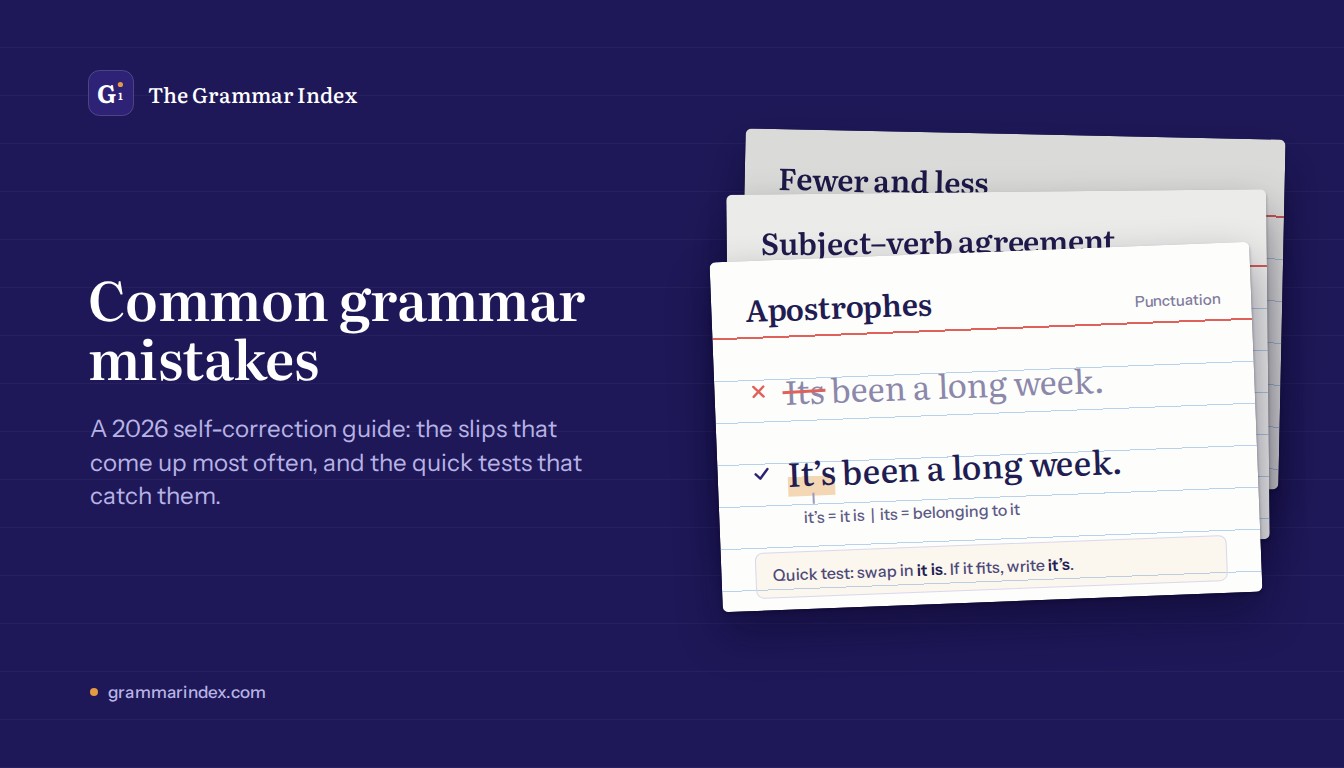
Apostrophes show possession or form contractions. In the student’s notebook, the apostrophe indicates that the notebook belongs to the student. In the student’s ready, it replaces letters in student is. Check the intended meaning: possessive its has no apostrophe, while it’s means it is or it has.
Know when colons, semicolons, and quotation marks help
A colon can introduce an explanation or list, but the words before it should form a complete clause: Bring three items: a notebook, a pen, and a folder. A semicolon can join two independent clauses that are closely related; use a full stop if you want a stronger break, or a coordinating conjunction when you want to express the connection directly. Keep quotation marks consistent with the style guide or publication you’re following. Conventions, including where other punctuation sits in relation to quotation marks, can differ.
| Mark | Typical function | Example |
|---|---|---|
| Comma | Separates items in a series | We packed pens, paper, and folders. |
| Semicolon | Connects closely related independent clauses | The rain stopped; we went outside. |
| Colon | Introduces an explanation or list after a complete clause | We went outside for one reason: the rain had stopped. |
A semicolon can connect two closely related independent clauses when each could stand as a sentence, but their connection is clearer when they stay together. In the examples above, a comma separates items, a semicolon links two complete thoughts, and a colon signals that an explanation follows. That distinction is more useful than choosing a mark based only on how long you’d pause.
Style guides may make different recommendations on details such as serial commas, quotation marks, and capitalization after a colon. If you’re writing for school, work, or a publication, follow its specified guide. Consistency helps readers focus on your ideas, and applying each mark according to sentence structure is a practical step as you master English punctuation and grammar.

Use a practical editing routine to apply grammar and punctuation
Knowing a rule is useful; applying it to your own draft is the real test. A repeatable editing routine helps you focus on one kind of decision at a time, rather than trying to catch every issue in a single read. To master English punctuation and grammar, edit for meaning first, then check the structure that carries it.
- Check meaning. Is each sentence saying what you intend? Look for unclear references or wording that could be read in more than one way.
- Check sentence structure. Find the subject and main verb. Make sure each sentence is complete and that clauses are joined correctly.
- Check agreement. Identify the subject before checking whether the verb matches it. Don’t let a nearby noun distract you.
- Check punctuation. Review sentence boundaries, commas, apostrophes, and marks connecting clauses.
- Check consistency. Look for repeated choices in spelling, capitalization, and style, and make them consistent with your purpose or required style guide.
A sentence-by-sentence grammar and punctuation check
Read one sentence at a time. Ask who or what it’s about, identify its main verb, and check that any clauses are complete and correctly connected. Then read it aloud: the sound may reveal awkward phrasing or an unclear transition, but use grammar rules to decide whether a construction is correct. Speech can guide your attention; it isn’t the final test.
Here’s a short edit in action:
Before: The volunteers has packed the supply's they are ready, but the checklist is missing.
After: The volunteers have packed the supplies. They’re ready, but the checklist is missing.
The revision corrects agreement between volunteers and have, removes the incorrect apostrophe from the plural supplies, and replaces the run-on with a full stop. The comma before but correctly joins the next pair of related ideas. Each change has a specific purpose.
Turn mistakes into a focused learning plan
Keep a brief record of corrections and group them by rule: subject-verb agreement, sentence boundaries, or apostrophe use, for example. When a pattern appears more than once, look up that rule and practise it with fresh examples. Then apply it to a new piece of your own writing; recognising the correction in an exercise is only part of learning it.
Choose a review rhythm you can maintain, such as checking your error notes during each writing session. Measure progress by whether the same errors appear less often, not by how quickly you edit. For a structured way to review grammar topics and worked examples, explore The Grammar Index.
Choose a structured reference to keep mastering English punctuation and grammar
Independent study is easier to sustain when you have a reliable way to move from a question to practice. If you’re unsure about a rule, look it up, read examples in context, try applying it, then revisit it later. A reference supports this cycle; your own writing remains the place to test whether you can use the rule clearly.
Choose a format that fits how you learn. A book, personal notes, or digital tool can all be useful, but none is a shortcut or a substitute for practising your writing. Look for:
- Clear explanations that make the rule understandable.
- Worked examples showing how it functions in real sentences.
- Practice and review suited to your current level and goals.
- An accessible format you can return to consistently.
What to look for in an English grammar reference
Check whether definitions explain the rule plainly and examples show what changes when the rule is applied. Practice is most useful when it targets a specific skill, while review helps you return to rules you’ve studied before. Consider your learning context, too: if English isn’t your first language, explanations in another language may provide helpful support as you build understanding.
How The Grammar Index can support continued study
The Grammar Index is a digital English grammar reference covering more than 300 topics, with definitions, worked examples, and quizzes. Its editions include original English, multilingual, and Key Stage 2 and 3 options. The multilingual edition is offered in 34 languages, which may help learners who benefit from language support while studying a rule.
The reference is available on web, Windows, iOS, and Android, so learners can choose among several formats. Its quizzes and spaced-repetition drills can support a study sequence: look up a point you encountered while writing, compare the explanation with the examples, try a quiz, then revisit the rule later. Audio features are also available. Learners can use the platform independently, while schools and other institutions can access editions through licensing, with integration options for Google Classroom and Microsoft Teams for Education.
To keep mastering English punctuation and grammar, choose a reference that makes it straightforward to find a rule and practise it at your level. If definitions, examples, quizzes, spaced-repetition review, or multilingual support match your study needs, explore The Grammar Index editions as one option for continued independent learning.
Put your grammar and punctuation knowledge into practice
Clear writing comes from understanding how words form sentences and choosing punctuation that helps readers follow their relationships. Build that foundation step by step, then edit with a focused routine: check meaning, sentence structure, agreement, punctuation, and consistency. To master English punctuation and grammar, keep practising these decisions in your own writing and revisit rules that need more attention.
A structured reference can make independent study easier by bringing explanations, examples, and practice together. The Grammar Index covers more than 300 grammar topics with definitions, worked examples, and quizzes. Its multilingual edition is offered in 34 languages, and the reference is available on web, Windows, iOS, and Android.
Explore The Grammar Index English grammar reference to find a resource that fits your learning needs. Each sentence you review is another opportunity to write with greater clarity and confidence.
Frequently Asked Questions
What is the difference between English grammar and punctuation?
English grammar is the system of rules and patterns that shapes words into phrases, clauses, and sentences. Punctuation uses marks to organise those sentences and clarify how ideas relate. They work together: grammar provides the structure, while punctuation helps readers interpret it. For example, “Let’s eat, Grandma” uses a comma to address Grandma; without it, “Let’s eat Grandma” suggests a very different meaning.
How can I master English punctuation and grammar as a beginner?
Start with basic sentence structure, including subjects, verbs, and complete clauses, then learn how punctuation marks clarify sentence boundaries and relationships. Study each rule through examples, practise applying it in short exercises, and then use it in your own writing. Review regularly rather than trying to learn every rule at once. A steady sequence helps you connect the rules and build confidence using them independently.
What should I learn first in English grammar?
Begin with parts of speech, then learn to identify subjects and verbs, recognise complete clauses, and distinguish complete sentences from fragments or run-ons. This order shows how individual words contribute to sentence structure before you tackle more complex rules. Once you can locate a sentence’s subject and main verb, it becomes easier to check agreement and decide whether ideas need a boundary or a connecting mark.
How can I improve my English punctuation in writing?
First check that each sentence has a clear boundary and that clauses are joined in a way that reflects their relationship. Then review commas for specific grammatical uses, apostrophes for possession or contractions, and other marks for accuracy. For example, a comma alone can’t usually join two complete sentences. Finish by checking consistency, especially if you’re following a style guide for school, work, or publication.
Can I learn English grammar and punctuation by myself?
Yes. Independent study can work well when you use a clear reference, examine worked examples, practise one rule at a time, and apply what you learn through self-editing. When you find an error, identify the rule behind it rather than correcting the sentence without explanation. Keep a record of recurring issues and revisit them with new examples. This creates a manageable learning cycle you can repeat at your own pace.
Why do I keep making the same grammar mistakes?
Repeated mistakes often persist because the underlying pattern hasn’t been identified, or because each correction is treated as an isolated fix. Group errors by rule, such as agreement, sentence boundaries, or apostrophe use. Review the relevant explanation, practise with new examples, then check for the same pattern in your own writing. Progress is easier to recognise when you track whether a particular error appears less often over time.
How do I know whether to use a comma, colon, or semicolon?
Use a comma for specific jobs such as separating items or setting off some introductory elements: “We packed pens, paper, and folders.” Use a colon after a complete clause to introduce an explanation or list: “Bring two things: a notebook and a pen.” Use a semicolon to connect closely related independent clauses: “The rain stopped; we went outside.” Check clause structure and follow one consistent style convention.