Best English Language Reference Books: A 2026 Comparison Guide
What if the most effective way to master English in 2026 isn't found in a dusty, thousand-page hardcover, but in a dynamic digital English grammar reference that speaks your native language? Many professionals and students feel completely overwhelmed by the endless sea of grammar titles currently on the market. It's exhausting to navigate the subtle contradictions between British and American standards, especially when you're searching for a resource that understands the specific linguistic hurdles of a non-native speaker. You deserve a tool that replaces this confusion with organized, steady progress.

Best English Language Reference Books: A 2026 Comparison Guide
What if the most effective way to master English in 2026 isn't found in a dusty, thousand-page hardcover, but in a dynamic digital English grammar reference that speaks your native language? Many professionals and students feel completely overwhelmed by the endless sea of grammar titles currently on the market. It's exhausting to navigate the subtle contradictions between British and American standards, especially when you're searching for a resource that understands the specific linguistic hurdles of a non-native speaker. You deserve a tool that replaces this confusion with organized, steady progress.
This guide promises to demystify the current landscape by comparing the definitive English grammar references of the year. You'll learn how to weigh the merits of classic physical volumes against the precision of modern mastery tools designed for a global audience. We'll explore the "Big Three" legacy titles and provide a logical framework to help you choose the right path. By the end, you'll have the clarity needed to select a reference that builds genuine confidence in your professional and academic writing.
Key Takeaways
- Identify the core differences between Swan’s comprehensive teacher guides and Murphy’s student-focused exercises to find your ideal learning level.
- Differentiate between the Chicago Manual of Style and the AP Stylebook to ensure your professional documentation meets specific industry standards.
- Compare the focused immersion of traditional books with the unparalleled efficiency of a digital English grammar reference for fast-paced work environments.
- Explore how multilingual support in 34 languages can simplify complex linguistic rules for non-native speakers seeking professional mastery.
- Develop a structured plan for transitioning from passive reading to active retention using modern spaced-repetition frameworks.
Table of Contents
- The Evolution of English Language Reference Books in 2026
- Comparative Analysis of the "Big Three" Grammar Titans
- Specialized References for Professional and Academic Excellence
- Physical Volumes vs. Digital Platforms: Format Comparison
- The Grammar Index: The Digital Evolution of the Reference Book
The Evolution of English Language Reference Books in 2026
By 2026, the traditional concept of a reference book has been completely reimagined. It is no longer just a heavy volume resting on a library shelf; it is a comprehensive, living resource that guides users through the intricacies of a global language. While basic AI spellcheckers offer quick fixes, they frequently fail to explain the underlying logic of complex syntax. A high-quality digital English grammar reference provides a definitive source of truth that helps learners understand the structural "why" behind every correction. This level of depth is essential for anyone aiming for high-stakes professional or academic success.
Modern standards are heavily influenced by both formal educational benchmarks and international linguistic frameworks. For students navigating demanding curriculum requirements, precision is non-negotiable. At the same time, global professionals need a reference that reflects how English is actively deployed across different continents. This dual demand has pushed forward-thinking resources like The Grammar Index to move beyond static text toward interactive, data-driven platforms that update as the language continues to evolve.
Prescriptive vs. Descriptive Grammar Philosophies
Understanding the difference between prescriptive and descriptive grammar is vital for choosing the right tool. Prescriptive grammar provides the established rules that govern formal, conventional English, forming the cornerstone of academic instruction. Descriptive grammar, however, observes how the language is actually used by speakers in 2026. A balanced approach is necessary for true mastery. You must know the formal rules to maintain professional authority, but you also need to understand descriptive trends to communicate effectively in casual or creative settings. Modern references prioritize this balance to ensure learners sound both accurate and natural.
Authority in the Age of AI and Corpus Linguistics
In an era where AI can hallucinate grammatical rules, publisher credibility matters more than ever. Leading linguistic authorities and rigorous modern platforms use vast databases of real-world language, known as corpus linguistics, to verify their guidance. These resources track how vocabulary and sentence structures change over time, preventing the use of obsolete guidelines. Even legacy works like The Chicago Manual of Style have evolved into searchable digital systems to remain relevant. Relying on verified solutions like The Grammar Index protects you from the errors often found in outdated editions or unvetted online snippets that generative models frequently scrape.
Comparative Analysis of the "Big Three" Grammar Titans
Selecting the right tool for linguistic mastery depends entirely on your specific objective. While thousands of resources exist, three specific titles have defined English instruction for decades. In 2026, these titans remain the benchmark for accuracy, though their formats and pedagogical philosophies vary significantly. Each serves a unique profile, ranging from the classroom instructor to the self-taught global professional. Understanding these differences is the first step toward building a personalized curriculum that yields results.
Practical English Usage (Swan): The Problem-Solver
Michael Swan's work is essentially an encyclopedia of linguistic hurdles. It organizes over 600 points alphabetically, making it a favorite for ESL teachers who need to explain why a specific phrasing feels unnatural. It excels at addressing common learner errors and clarifying the subtle differences between similar words. However, beginners might find the lack of a linear path confusing; it's a reference for looking things up rather than a book you read from cover to cover. If you're looking for a quick answer to a specific nuance, it remains peerless in the field of formal instruction.
English Grammar in Use (Murphy): The Workbook King
Raymond Murphy's classic utilizes a highly effective "split-page" system that has been replicated by dozens of competitors. The left side explains a concept through clear diagrams and examples; the right side offers immediate practice exercises. It's the gold standard for intermediate learners who want to build a solid foundation through systematic repetition. While it's excellent for core tenses, it doesn't always offer the technical depth required for high-level academic research. For those seeking a modern pedagogical benchmark, exploring Purdue Online Writing Lab's grammar resources can provide additional context on standard conventions and mechanics.
For the most rigorous academic deep-dives, Quirk et al.'s "A Comprehensive Grammar of the English Language" remains the definitive structural map. It's a massive, technical volume designed for linguists and advanced scholars rather than casual learners. Choosing between these titans depends on whether you need a quick fix for a specific error, a steady curriculum for daily study, or a total structural breakdown of the language's history and syntax.
Despite their brilliance, these physical books can be cumbersome to search during a busy workday. A modern digital English grammar reference often takes the best of these philosophies and adds interactive elements like instant search and multilingual support. If you want the depth of a legacy titan with the speed of a mobile app, you'll find that The Grammar Index serves as the logical evolution of these traditional study habits, combining authoritative rules with cutting-edge accessibility.
Specialized References for Professional and Academic Excellence
High-stakes writing requires more than just knowing where to place a comma; it demands absolute consistency in style and tone. Professionals often transition from general textbooks to specialized guides that dictate specific editorial standards for their industry. While some scholars still value the weight of a physical book, a Pew Research Center study on print versus digital reading highlights the steady adoption of electronic formats. This shift is particularly evident in fast-moving corporate environments where a digital English grammar reference offers the speed and precision that traditional volumes cannot match.
Style Guides for Business and Media Consistency
Style guides serve a different purpose than standard grammar books because they establish a specific brand voice rather than just teaching universal rules. The "Chicago Manual of Style" is the definitive choice for book publishers and long-form editors, offering exhaustive guidance on punctuation and complex citations. On the other hand, the "AP Stylebook" remains the industry standard for journalists and media professionals who prioritize brevity and clarity in news reporting. Strunk & White’s "The Elements of Style" continues to be a controversial classic; it's praised for its focus on lean prose but criticized for its rigid, prescriptive tone. For those preparing documents that require absolute authority, consult our formal English grammar guide to ensure your work meets these rigorous professional standards.
Academic Reference Tools for Higher Education
Academic writing introduces unique linguistic challenges, such as the frequent use of nominalization and the strategic application of the passive voice. While standard grammar references often discourage passive structures, they're essential in scientific research to maintain an objective tone. Specialized academic tools also help students master the complex grammar of citations required by APA, MLA, or Harvard formats. In 2026, there's an increasing emphasis on the use of "Hedges" and "Boosters." These linguistic markers allow scholars to calibrate the certainty of their claims, which is a vital skill for publishing in peer-reviewed journals.
The rise of technical English references for STEM and business professionals highlights a shift toward niche mastery. Utilizing a digital English grammar reference that incorporates these specialized style rules allows you to switch between academic and professional tones with ease. This adaptability is the hallmark of a modern communicator who understands that grammar is not a one-size-fits-all set of rules, but a toolkit designed for specific professional contexts.

Physical Volumes vs. Digital Platforms: Format Comparison
Choosing between a physical volume and a digital English grammar reference often comes down to a trade-off between tactile focus and functional efficiency. Physical books provide a distraction-free environment that some learners find essential for deep study. There's an undeniable sense of progress as you turn the pages of a comprehensive manual; it's a sensory experience that can help anchor complex information. However, in a fast-paced professional environment, the weight and static nature of paper can become a significant barrier to progress.
The Searchability Factor and Learning Friction
Searching through the index of a 1,000-page hardcover is a slow, manual process. Busy professionals don't have the luxury of time to flip through dozens of pages to find a specific rule on conditional clauses. A digital English grammar reference eliminates this friction by providing a powerful search bar that delivers instant results. Beyond speed, digital tools offer hyperlinked cross-references. This allows you to jump between related topics, such as verb tenses and mood, without losing your place. This interconnected structure mirrors how we actually process information in 2026, making the learning journey feel more like a navigable map than a dense forest.
Physical books also suffer from the "Static Content" problem. Once a book is printed, its rules are frozen in time. As syntax evolves and new professional standards emerge, a physical volume can't adapt. Digital platforms solve this through continuous updates, ensuring you're always learning the most current usage. Consider these cost-benefit factors:
- Longevity: Physical books are a one-time purchase but can become outdated as language standards shift.
- Accessibility: Digital tools are portable across all devices, allowing you to check a rule during a meeting or on a commute.
- Cost: While digital access may involve a subscription, it includes ongoing updates that a physical book lacks.
From Passive Reading to Active Retention
Simply reading a grammar rule once is rarely enough to ensure long-term mastery. Many students struggle with "passive reference," where they understand a concept in the moment but forget it by the time they start writing. Modern digital platforms move beyond this by incorporating spaced repetition. This methodical approach uses timed reviews to move information from short-term to long-term memory. Instead of just looking up a rule, you engage in interactive drills that reinforce the knowledge. This transition from passive reading to active practice is what truly builds writing confidence.
If you're ready to move beyond static textbooks, you can explore the digital evolution of grammar reference books to start your journey toward mastery today.
The Grammar Index: The Digital Evolution of the Reference Book
The Grammar Index represents the definitive shift from static text to a dynamic, living ecosystem. It isn't merely an e-book or a PDF of a traditional manual; it's a comprehensive digital English grammar reference designed to meet the rigorous demands of 2026. With over 300 topics organized into a logical, searchable sequence, it provides the structural depth of a legacy titan with the speed of a modern application. For educational institutions, the platform integrates seamlessly with Google Classroom and Microsoft Teams. This allows teachers to assign specific reference modules as part of a planned curriculum, ensuring students have authoritative guidance at their fingertips during every assignment.
Multilingual Support: A Reference That Speaks Your Language
Mastering complex syntax is significantly harder when the explanation itself is written in a language you're still learning. The Grammar Index Multilingual Edition solves this problem by providing support in 34 different languages. This feature allows learners to demystify English rules using their native tongue, which leads to much faster comprehension and reduced cognitive load. For example, a Somali or Bengali speaker can instantly clarify complex verb tenses by viewing an explanation in their first language. This bridge between native intuition and English mastery is essential for global learners. You can explore this Multilingual English learning tool to see how these translations transform the study experience.
Closing the Gap with Spaced Repetition Drills
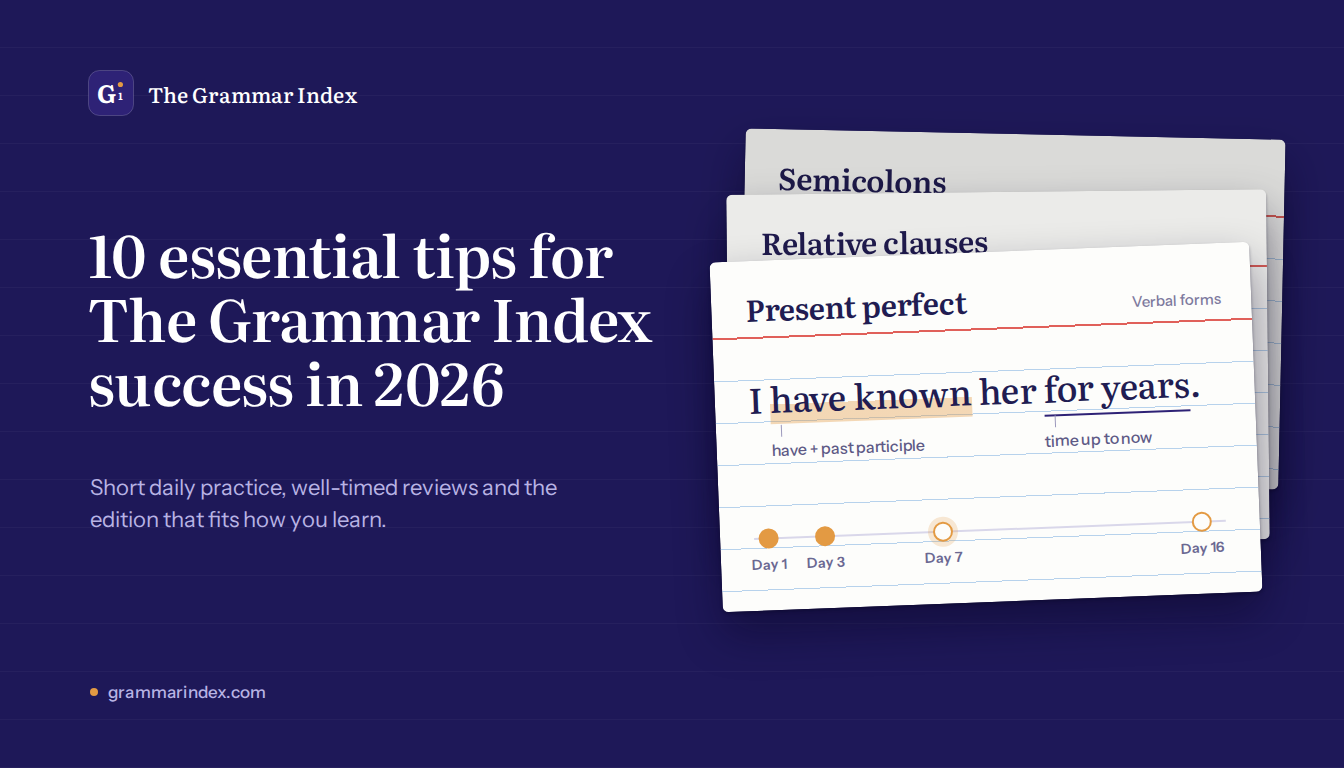
While traditional books are excellent for looking up a rule, they often fail to help you actually remember it. The Grammar Index functions as a living reference book that prioritizes active retention over passive reading. By utilizing spaced-repetition drills, the platform tracks your progress across all 300+ topics. It identifies the specific rules that cause you confusion and schedules targeted reviews at mathematically optimal intervals. This methodical repetition ensures that once you look up a rule, you eventually move it into your long-term memory. It's a structured path to progress that eliminates the need to check the same grammatical point repeatedly.
In 2026, the logical choice for a global professional or a serious student is a tool that is as inclusive as it is authoritative. Whether you're using The Grammar Index Original Edition for general mastery or the Key Stage 2 & 3 Edition for school-level precision, you're engaging with the future of linguistics. This digital English grammar reference doesn't just provide answers; it builds the confidence and skill set required for high-stakes writing in a globally connected world.
Embracing the Future of Linguistic Mastery
Choosing the right path to English proficiency in 2026 requires a balance between traditional authority and modern efficiency. While legacy titans provide a foundational map, your success depends on selecting a format that matches your professional or academic pace. Whether you require the rigid consistency of a style guide or the intuitive support of a multilingual platform, the goal remains the same: clear, confident communication.
A high-quality digital English grammar reference does more than just answer questions; it transforms passive reading into active skill. By utilizing tools that offer 34-language support and alignment with the KS2 and KS3 UK National Curriculum, you ensure your learning is both global and precise. Advanced spaced-repetition technology further solidifies these rules, making them a permanent part of your writing toolkit.
Start your journey toward linguistic mastery with The Grammar Index and experience a methodical approach to learning that grows with you. You have the potential to replace confusion with organized progress; we're here to guide you every step of the way.
Frequently Asked Questions
What is the most comprehensive English grammar reference book for 2026?
While Practical English Usage by Michael Swan remains a classic choice for teachers, the most comprehensive modern solution is a platform like The Grammar Index. It covers over 300 topics with clear definitions and worked examples. Unlike static books, this digital English grammar reference updates in real time to reflect evolving usage. It provides a methodical path to mastery that combines traditional depth with cutting-edge accessibility for global students and professionals.
Is Raymond Murphy’s "English Grammar in Use" still relevant for modern learners?
Raymond Murphy's classic English Grammar in Use remains highly relevant for intermediate learners who appreciate its structured workbook format. Its famous split-page layout is excellent for focused study sessions. However, many 2026 learners find they need more than just static exercises. Modern alternatives now incorporate spaced-repetition drills to ensure long-term retention. These digital tools build upon the foundations Murphy established while adding the searchability and portability required for a professional environment.
How do digital grammar apps compare to traditional physical reference books?
Digital grammar apps offer superior searchability and portability compared to traditional 1,000-page physical volumes. While a book provides a tactile experience, a digital English grammar reference reduces learning friction by delivering instant answers through a search bar. Additionally, interactive platforms include audio features and quizzes that physical books can't provide. These tools are designed for active engagement, helping users move rules from short-term memory to long-term mastery through systematic repetition and spaced drills.
Which grammar book is best for the UK National Curriculum (KS2 and KS3)?
For students following the UK National Curriculum, the Key Stage 2 & 3 Edition of The Grammar Index is the ideal choice. It's specifically aligned with the curriculum requirements for these levels, ensuring all necessary terminology and frameworks are covered. Unlike general textbooks, this edition integrates with Google Classroom and Microsoft Teams for Education. This makes it a seamless resource for both classroom instruction and home study, providing organized progress for younger learners.
Do I need separate reference books for American and British English standards?
You don't necessarily need separate books if you choose a comprehensive reference that addresses both standards. Most Big Three titans, such as Swan's Practical English Usage, highlight the differences between British and American English throughout their text. Modern digital platforms often allow you to toggle between these standards or provide clear side-by-side comparisons. This approach helps you maintain consistency in your professional writing without the need to carry multiple heavy physical volumes.
Can I learn English grammar effectively using only a reference book without a tutor?
You can learn effectively on your own if you use a reference that provides a logical, structured path. While a tutor offers personalized feedback, a methodical digital reference with worked examples and quizzes can simulate that guidance. The key to self-study is active practice rather than passive reading. By engaging with spaced-repetition drills, you can build confidence and mastery independently. This structured progression ensures you don't just understand a rule once but retain it forever.
What are the best grammar references for non-native speakers needing native translation?
The Grammar Index Multilingual Edition is the premier choice for non-native speakers who need explanations in their first language. It offers support in 34 different languages, including Somali, Bengali, and many others. This feature clarifies complex verb tenses and syntax rules instantly, removing the barrier of trying to learn English through English. It's a global innovator in linguistics, making high-level learning accessible to students and professionals from diverse cultural backgrounds who want to study efficiently.
Why should schools consider digital institutional licensing over physical textbooks?
Schools should consider institutional licensing because it offers greater flexibility and better integration with modern educational technology. Digital licenses allow for seamless deployment across web, Windows, iOS, and Android devices. Platforms like The Grammar Index integrate directly with Microsoft Teams and Google Classroom, simplifying the assignment process for teachers. Furthermore, digital references are more cost-effective over time as they receive updates automatically, ensuring students always have access to the most current linguistic standards.